Rollout & work orders
A fibre rollout contractor delivering FTTH survey and construction
Thousands of fibre jobs, tracked in spreadsheets and chat
Crews sent out with no record, photos of finished work lost in message threads, and days every month to work out what had actually been delivered.
BeforeThousands of jobs across a spreadsheet and a group chat
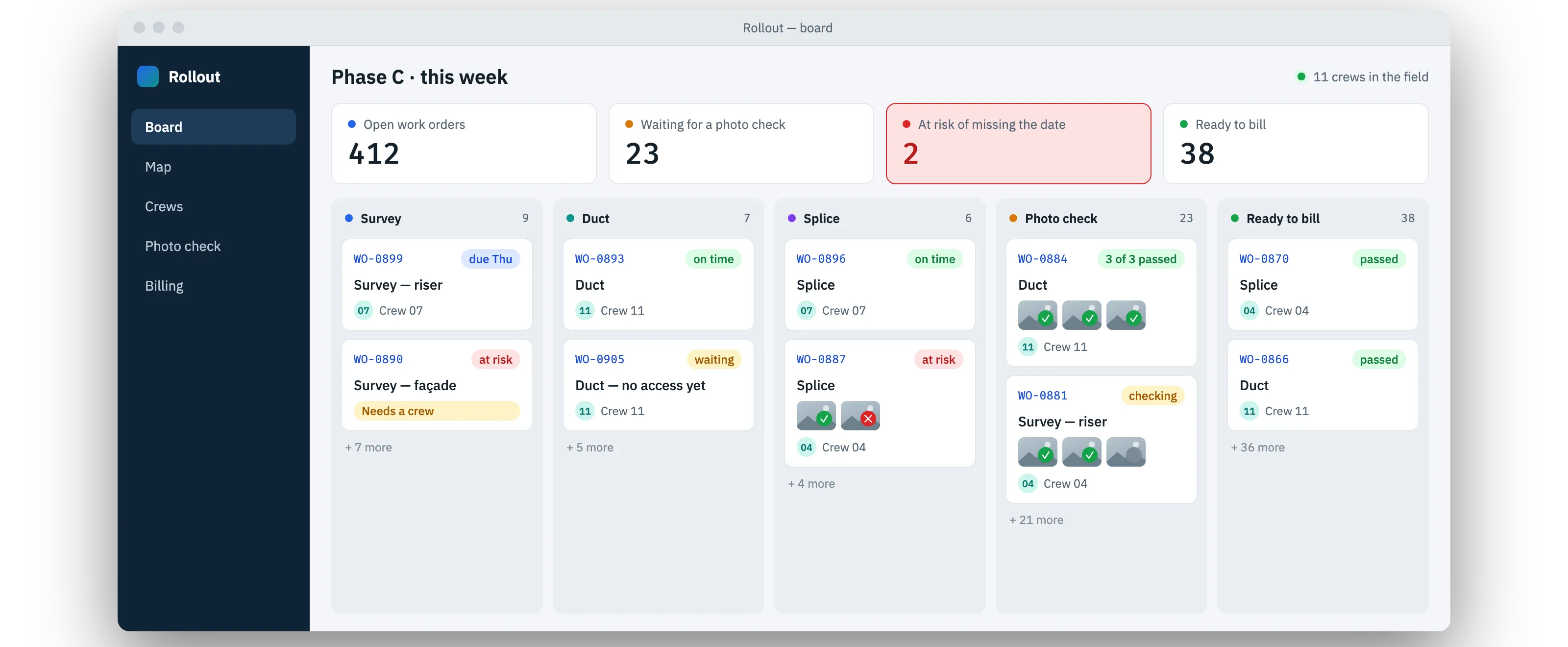
AfterEvery job, crew and photo in one place, billed once photos pass
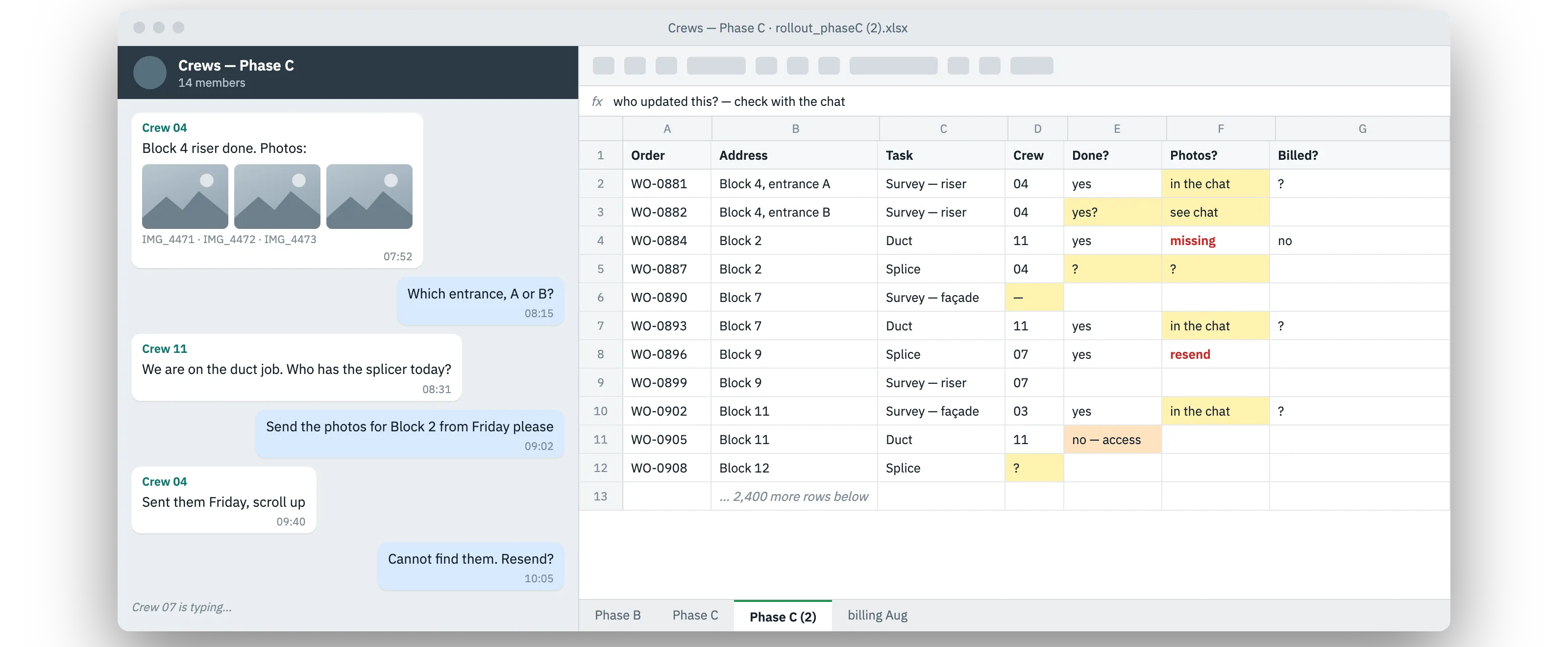
Before
- 1Proof of work, lost in the group chat
- 2Which crew went where? Nobody wrote it down
- 3Days every month to work out what was delivered
After
- 1The two late jobs flagged before the deadline, not after
- 2Nothing is billed until its photos pass the check
Illustrative interface. All values synthetic.
- Sector
- Network infrastructure
- Scale
- Mid-market
- Duration
- 43 days
- Engagement
- Build sprint
In plain terms
- The problem
- A company that lays fibre-optic internet cable was keeping track of thousands of jobs in spreadsheets and chat messages. Nobody could say for certain which crew was where, or whether the photos that prove a job was finished had actually been checked.
- What was delivered
- We built the system they use to take the work in, send the crews out, and check the photos before anyone gets paid for the job.
- Outcome
- It was running properly in 43 days. Then we tested it with half a million orders to be sure it would not slow down when it got busy — and found a fault making it about seven times slower than it should be. We fixed it before anyone ever felt it.
The detail
The problem
Fibre survey and construction work orders were tracked across spreadsheets and messaging apps. Crews were dispatched without a record, evidence came back as photos in chat threads, and reconciling what was delivered against what was reported took days every month.
Constraints
- Field crews work on phones, often on poor connections, and abandon anything slow
- Two distinct workflows — survey and construction — with different evidence requirements
- Quality evidence had to be reviewable and auditable, not merely collected
- A rollout programme accumulates history indefinitely, so it had to stay fast as the table grew
Approach
- Modelled survey and construction as distinct workflows over one shared work-order spine, with the rules in the schema rather than scattered through the code
- Built mobile-first, including offline drafts that are account-scoped and replay safely
- Load-tested against a synthetic half-million-order history rather than assuming it would hold
- Traced the resulting latency to concurrent writes clearing in-flight summary calculations, causing duplicate expensive work
- Wrote a full handover pack alongside the build, not after it
What was delivered
- Work-order intake, planning and crew dispatch across both survey and construction phases
- Execution tracking with quality and evidence review, where replacement never deletes prior evidence
- Customer status export and reconciliation
- Role-based access, crew ownership enforcement, team assignment and scheduled notifications
- A field systems manual and a continuation pack so the work can be picked up by anyone
Outcome
p95 under 300 concurrent users
6.7 s
under 1 s −89%
Before: 6.7 s. After: under 1 s.
Against a synthetic half-million-order history, with zero request errors, inside a two-second target
p95 under 200 concurrent users
5.1 s
about 0.5 s −90%
Before: 5.1 s. After: about 0.5 s.
From nothing to production
—
43 days
Before: —. After: 43 days.
330 commits, 60 tables, 53 endpoints, 43 migrations
Scheduled notification throughput
—
15,000 in under 16s
Before: —. After: 15,000 in under 16s.
Generated alongside live 200-user activity
Stack
Next.jsTypeScriptPostgreSQLNeonDrizzle ORMClerkVercel
Where AI helped, and where it didn't
Thirty-three thousand lines in six weeks is what AI-assisted development makes possible. Deciding to load-test at half a million orders before the client ever got there — and recognising that a p95 of nearly seven seconds was a cache-invalidation fault rather than a database problem — is not something a model suggests. You have to have been on the wrong end of it before.
The situation
Fibre rollout is a volume business with a paperwork problem. Each site needs a survey, then construction, each with its own evidence requirements, each done by a different crew, and all of it has to reconcile against what the customer believes was delivered.
This operation ran it on spreadsheets and messaging apps. Work orders were assigned verbally or in chat, evidence came back as photos in a thread, and month-end reconciliation meant cross-checking two systems by hand. Disagreements with the customer were settled by whoever had kept better notes.
Why nobody had already fixed it
Not because the problem was hard to describe. Every person in that operation could describe it.
The work order tools that exist are built either for a telco’s own field force or for a generic service desk, and a rollout contractor is neither: the evidence rules come from the customer’s contract, not the software vendor’s idea of a job. Configuring a platform to match takes a consultant who understands both, and the licence cost lands before anyone has proved it fits. The quotes that came back were for a programme, not a tool.
So the spreadsheet stayed, because it was the only thing that would bend.
Why the schema came first
Sixty tables and 43 migrations before there was much of an interface. Deliberate.
Survey and construction look similar enough that the tempting move is one generic “work order” with a type flag and conditional logic sprinkled through the code. That holds until the evidence requirements diverge — which they do immediately — and then the rules live in fifteen places and nobody can say with confidence what the system will accept.
Instead: two distinct workflows over a shared spine, with the rules expressed in the data model. It costs more up front, and it is why a six-week build did not need rewriting in week seven.
work order board · phase B + C / this week
| order | phase | task | crew | evidence | sla |
|---|---|---|---|---|---|
| WO-24-0881 | B | Survey — riser access | Crew 04 | passed | on time |
| WO-24-0884 | C | Construction — duct | Crew 11 | review | on time |
| WO-24-0887 | C | Construction — splice | Crew 04 | rejected photo unreadable | at risk |
| WO-24-0890 | B | Survey — façade route | unassigned | none | at risk |
| WO-24-0893 | C | Construction — drop cable | Crew 07 | passed | on time |
The part that mattered most happened after it worked
The system worked. That is not the same as knowing it will keep working.
A rollout programme accumulates history indefinitely, so we seeded a synthetic history of roughly half a million orders and 1.6 million tasks, and ran concurrent mixed load against it.
It failed. A p95 of around five seconds at 200 concurrent users and nearly seven at 300, against a two-second target.
The cause was not the database. Concurrent writes were clearing in-flight summary calculations, so several requests each started the same expensive aggregation instead of sharing one result. A classic stampede — invisible at single-user scale, obvious at 300.
The fix keeps in-flight work shared and marks its result expired if a write lands mid-calculation, so the next request rebuilds rather than serving something stale. Historical aggregates survive unrelated writes, work-order writes invalidate them, and the outer summary can never outlive the snapshot inside it.
After that: roughly half a second at 200 users and under a second at 300, with zero request errors and comfortable headroom against the target.
What it runs on
Postgres through Drizzle, with the migrations checked in — 43 of them, which is what a data model that was allowed to change honestly looks like. Clerk for identity. Vercel Blob holds the evidence photos. Leaflet with clustering draws several thousand sites without collapsing. Email goes out through Resend, and browser push through web-push, which together generated 15,000 scheduled notifications in under sixteen seconds while 200 users were live on the system.
The tests run against a real embedded Postgres rather than mocks. Mocked database tests pass while the constraint you actually rely on does not exist.
It says when it is unwell
A rollout system that silently stops reconciling is dangerous rather than merely broken: the numbers keep looking plausible and the disagreement with the customer arrives a month later.
So the system reports on itself — throughput, queue depth and the health of the scheduled work — on a panel the operations lead can read without asking anyone. Evidence that fails review is a visible count, not a silent rejection, and the crew that submitted it is told rather than left to discover it at month end.
Reporting the failing run, not just the passing one
The internal test notes record the failed run in full, with the explicit observation that a latency failure is still a failure even when the test process exits cleanly — and that a favourable comparison between two differently-configured runs is encouraging evidence rather than a controlled measurement.
That is the standard the documentation is written to. A performance report that only records the good run is worth nothing to whoever inherits the system.
The handover is part of the work
Current state, decisions and business rules, workflow and status model, architecture, operations and deployment, testing, a prioritised backlog, and a continuation brief.
Every outside build raises the same question — what happens once we are no longer on it. The answer has to be a real one, written down, before the client thinks to ask.
What actually changed
Before, the answer to “is this job finished, and can we bill it” lived in a photo thread and somebody’s memory, and the customer’s answer was often different.
Now it is a record with evidence attached and a review state, and both sides are looking at the same thing. Month-end stopped being a negotiation about whose notes were better.
Client anonymised. Most of this work touches commercial or operational internals; references available on a call.